
A crown slot game offers no dependable route to profit: on a conventional random slot, betting patterns cannot make the next spin more favorable. Useful strategies therefore focus on understanding the specific game, comparing its disclosed mathematics, limiting spending, and avoiding decisions based on misleading patterns. This article explains those choices without presenting risk management as a winning system or inventing specifications for an unidentified Crown title. Learn the best info about Ganda cuan.
Because no developer, operator, or exact game version has been specified, the guidance below remains deliberately general. Before applying it, check the rules of the game actually on your screen. Participate only where you meet the applicable legal requirements, and treat not playing as a valid decision.
Can a strategy help you win a crown slot game?
A strategy cannot reliably predict or improve the next outcome of a conventional random crown slot game. What preparation can improve is your understanding of the wager and your control over how much money you expose to loss. The distinction matters: choosing a lower-cost game or declining an unaffordable bet changes your financial exposure, not your ability to command a winning combination.
The phrase “winning strategy” can conceal three different objectives. One person wants a greater probability of receiving any payout. Another wants a chance at an unusually large prize. A third simply wants to finish a session ahead. Those are different outcomes, and a headline maximum prize tells you little about the likelihood of achieving any of them.
For clarity, separate your decisions into two categories:
- Game characteristics: The published rules, payout structure, theoretical return, and conditions attached to special features. Read these before deciding whether to participate.
- Personal boundaries: The amount you are prepared to lose, the time you are prepared to spend, and the circumstances under which you will stop. Set these independently of recent results.
Do not judge a decision exclusively by what happened afterward. A carefully limited wager can lose, while an impulsive, unaffordable wager can win. Neither result establishes whether the underlying decision was sensible.
A practical exercise is to write one sentence before opening the game: “I am considering this as paid entertainment, not as a way to meet expenses.” If that statement does not describe your actual purpose, reconsider the session. Money needed for rent, debt payments, food, transportation, or other commitments should not become a gambling budget.
Identify the exact game before comparing strategies
Start with identification rather than assumptions. For this article, “crown slot game” is a search phrase, not a verified specification sheet. Without an exact title and developer, it would be misleading to assign it a particular reel layout, return percentage, jackpot, or bonus mechanic.
Open the information panel and record the full game name, developer, and any version information provided. Then inspect the rules displayed within that installation. For example, Great Britain’s Gambling Commission requires accessible explanations of applicable rules, winning outcomes, and relevant prize information before customers commit to gamble. That requirement is jurisdiction-specific, but it illustrates the information worth looking for.
Use a short identification checklist:
- Exact title: Copy the complete name rather than relying on the word “Crown” or an icon.
- Developer: Distinguish the company making the game from the operator offering access.
- Displayed rules: Locate the paytable, bet calculation, feature conditions, and any stated restrictions.
- Account context: Establish whether you are using cash, restricted promotional funds, or a demonstration balance.
- Game state: Check whether the screen represents the base game, an active feature, or another clearly described state.
Apply the same discipline when searching for a crown slot machine in a physical venue. A cabinet’s appearance is not enough to evaluate the wager. Read the machine’s own help screens and ask staff to explain controls you cannot locate; do not ask them to predict outcomes.
Likewise, searching for a crown casino game does not establish which rules apply to your account. Treat an external review as a starting point for questions, not as a substitute for the current information supplied with the actual game. If essential information remains unclear, leave the wager unplaced.
Read the paytable as a set of conditions
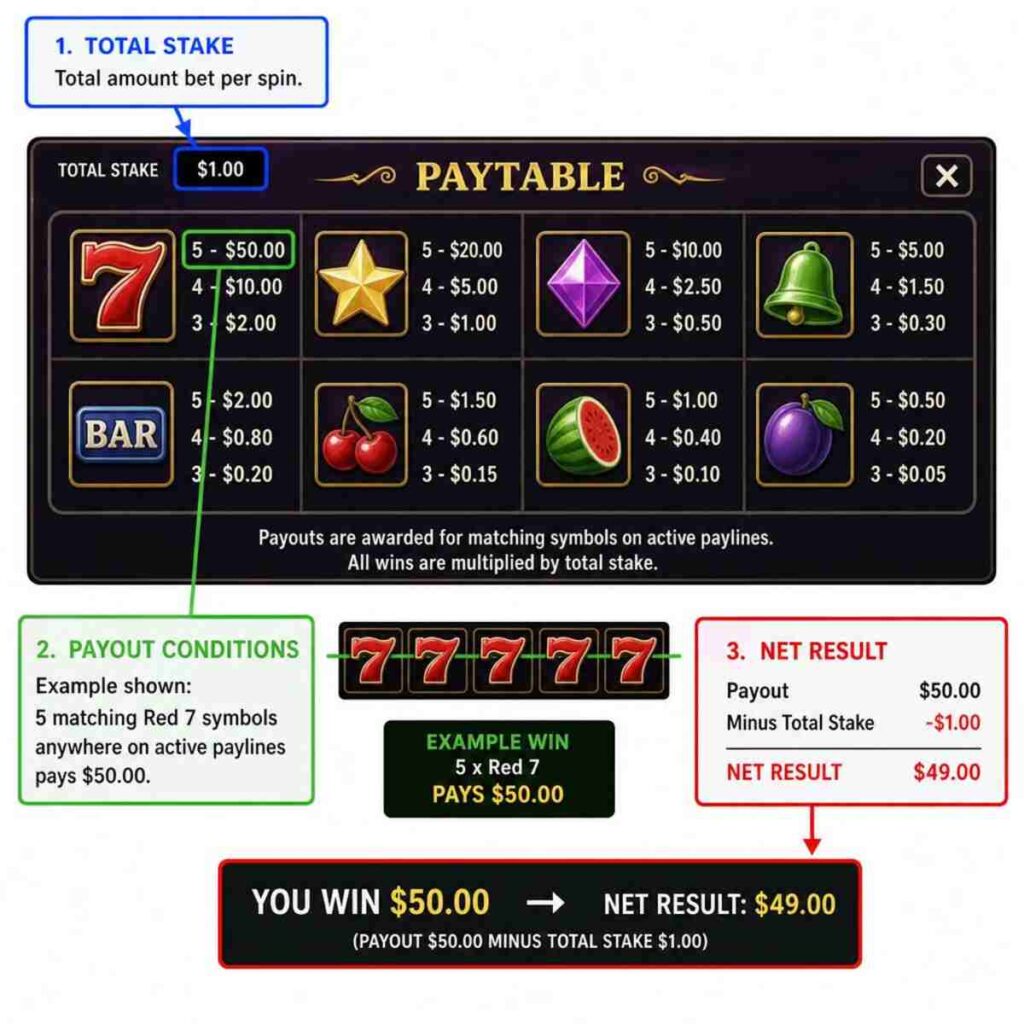
A paytable is useful only when you understand the conditions behind each displayed amount. Instead of looking first at the largest prize, work from the smallest unit of the wager upward. Establish what one spin costs, what constitutes a qualifying result, and how the displayed payout relates to that cost.
Regulatory guidance identifies winning-outcome descriptions, payout information, jackpot operation, and feature-entry rules as relevant elements of game explanations. Use those categories to structure your reading rather than assuming familiar symbols behave the same across games.
Establish the complete cost of a spin
Find the total monetary stake before pressing the spin control. If the interface separates denomination, credits, lines, or optional components, determine how those settings combine. Do not confuse a small-looking credit number with a small cash commitment.
Consider a purely hypothetical interface showing a $0.05 denomination and a 20-credit total wager. Multiplying those figures gives a $1 spin, not a five-cent spin. This example does not describe a particular Crown title; it demonstrates why translating credits into currency is essential.
Repeat the check after changing settings or reopening the game. Your personal rule should be simple: if you cannot state the full cost of the next action in dollars, do not take it.
Distinguish a payout from a profit
A returned amount is not necessarily a net gain. In a hypothetical $1 spin that returns $0.40, the net result is a $0.60 loss. A $1 return on that same stake merely restores the amount wagered.
This distinction is especially important when interpreting celebratory presentation. The Gambling Commission has specifically addressed slot sounds and imagery that suggest a win when the return equals or falls below the stake. Regardless of presentation, evaluate the arithmetic rather than the animation.
Check symbol and feature exceptions
Read the exceptions as carefully as the headline rules. Determine whether special symbols substitute for others, whether particular positions matter, and whether an advertised multiplier applies to a component prize or the total wager. Where the rules do not answer a material question, do not supply an optimistic interpretation yourself.
A useful comprehension test is to explain one ordinary winning example in your own words. Include the required arrangement, the applicable stake, and the resulting payout. If your explanation depends on “probably” or “I assume,” return to the rules before spending money.
What do RTP and house edge tell you?
Return to player, or RTP, describes the theoretical proportion of total stakes returned as prizes over a sufficiently large volume of play. House edge expresses the complementary expected share retained by the house. Neither figure predicts your session balance, guarantees a minimum return, or tells you when a prize will arrive.
For an illustrative game with a 96% theoretical RTP, the corresponding house edge is 4%. That relationship is arithmetic: 100% minus 96% equals 4%. These figures are hypothetical and must not be mistaken for verified specifications of a crown slot game.
Use total wagering rather than deposits
The relevant base for expected-loss arithmetic is the amount wagered, including money repeatedly returned and wagered again. It is not merely the initial deposit. The Gambling Commission’s monitoring guidance explicitly distinguishes turnover—the total of stakes, including reinvested winnings—from the prizes awarded during play.
Suppose, purely for illustration, that you make 200 wagers of $0.50 each. Your total wagering is $100. If the hypothetical house edge is 4%, the mathematical expected loss for those wagers is $4, calculated as $100 multiplied by 0.04.
That calculation does not mean you should expect to finish exactly $4 down. It is an average across possible outcomes under the assumed game model, not a forecast for one realized sequence. Your actual result can differ substantially, and the calculation does not establish that your starting balance can sustain the planned wagers.
Compare like with like
If two otherwise comparable games disclose different RTPs, the higher figure represents a lower theoretical house edge. However, that comparison alone cannot establish which game will produce a better result during your next session. Short-run results also vary with the distribution of prizes; regulatory monitoring therefore considers volatility alongside theoretical return.
Ask whether the figures describe the same kind of wager and include the same relevant components. Do not compare an unexplained promotional percentage with an in-game theoretical return as though they were interchangeable. If the basis of a number is uncertain, label it uncertain rather than converting it into a recommendation.
Most importantly, do not continue playing to “receive your RTP.” A theoretical average is not a personal entitlement. It creates no obligation for the next spin to compensate you for earlier losses. On a random machine, previous wins and losses do not change the current game’s odds.
Understand volatility without treating it as a forecast
Volatility concerns the variability of outcomes rather than the average percentage returned. In the Gambling Commission’s technical explanation, highly volatile games may concentrate returns in very large but rare prizes, while lower-volatility games may emphasize smaller, more frequent awards. A volatility description is therefore relevant to the possible shape of play, but it is not a timetable for wins.
This distinction helps explain why two games with similar theoretical returns can feel different. The average alone does not describe how unevenly the possible payouts are distributed. Research published in International Gambling Studies also treats volatility as a potentially important influence on player behavior, rather than simply a decorative game label.
When evaluating a game, separate three questions:
- Average return: What theoretical RTP is disclosed for the relevant wager?
- Outcome distribution: What does the available information indicate about variability and prize concentration?
- Personal suitability: Would losing the entire planned expenditure create financial or emotional difficulty?
The third question should determine your boundary. A high tolerance for uncertainty is not the same as an ability to afford losses, and confidence does not expand a budget.
Avoid interpreting a volatility label as permission to persist. A run without a substantial payout does not, by itself, establish that a large award is approaching. Equally, receiving a large award does not prove that the game must now stop paying; those conclusions do not follow for independent random outcomes.
If a game’s outcome variability makes you uncomfortable, the appropriate response is not necessarily to allocate more money. Reduce your exposure or decline to play. No entertainment choice requires you to tolerate uncertainty that undermines your ability to stop.
Build a spending boundary before opening the game
Set a maximum loss using money that remains genuinely discretionary after essential obligations and other priorities. Then decide whether gambling is how you want to spend that money at all. A limit should reflect an acceptable entertainment expense, not an amount you hope will be sufficient to reach a bonus or recover a previous loss.
The Connecticut Council on Problem Gambling includes advance budgeting, breaks, and learning how games work among its responsible-gambling guidance. These practices are safeguards, not assurances that gambling will remain harmless or profitable.
Make your boundary operational rather than aspirational:
- Choose the maximum loss in advance. Write it down before viewing promotions or beginning play. If losing that amount would interfere with commitments, choose a smaller amount or do not play.
- Set an end time. Use an external reminder so that ending does not depend entirely on remembering while engaged with the game.
- Decide against additional deposits. Treat the original decision as complete rather than reopening it after losses.
- Separate essential funds. Do not borrow, use money reserved for bills, or rely on an anticipated payout to replace spending.
- Specify the stopping action. Decide whether you will close the application, leave the venue, or move immediately to a planned non-gambling activity.
For example, a written boundary might say: “I will spend no more than my chosen entertainment amount, stop at my chosen time, and make no additional deposit.” This is a template, not a recommended dollar amount. There is no universal gambling budget appropriate for every reader.
Also consider your position across sessions. Starting a new session does not erase earlier expenditure, and switching operators does not create a fresh household budget. Keep the relevant spending period consistent with how you manage your finances.
If you find yourself negotiating exceptions before you have even started, pause. The purpose of advance planning is to avoid making the same financial decision repeatedly under changing emotional conditions. A boundary that disappears whenever it becomes inconvenient is not functioning as a boundary.
Keep stake decisions separate from recent outcomes
Choose any stake by reference to your predetermined spending boundary and the game’s disclosed rules. Do not increase it because a sequence appears unfavorable or because a recent payout has created confidence. On a conventional random slot, neither sequence supplies a predictive advantage for the next spin.
Increasing stakes can increase the dollars exposed on each subsequent wager without solving the underlying uncertainty. Consider a hypothetical loss-chasing sequence of $1, $2, $4, $8, and $16. Five losing wagers consume $31, even though the sequence began with a single dollar.
The example illustrates escalation, not a system to try. No particular payout is guaranteed to occur before a personal limit, available balance, or game limit is reached. A progression changes the arrangement of your wagers; it does not establish an entitlement to recovery.
Use a simpler decision rule: do not let the preceding spin trigger an unplanned increase. If you want to reconsider a stake, end the session and assess the question outside active play. There is no need to make that decision while a game is waiting for another input.
Apply the same caution after a win. A returned balance is still money available to keep, spend elsewhere, or lose through further wagering. Calling part of it “the casino’s money” obscures the fact that choosing to wager it is a new financial decision.
The practical objective is not to discover a magically correct bet size. It is to prevent a sequence of results from rewriting the amount you had already decided was acceptable to spend.
Evaluate bonus features by their actual conditions
A feature should be assessed as a defined component of a game, not as evidence that ordinary probability has been suspended. Read how it is triggered, what it costs if separately purchased, how awards are calculated, and whether special limits apply. Regulatory guidance specifically identifies feature-entry rules and jackpot operation as information relevant to understanding a game.
If the game offers a paid feature purchase, translate its price into dollars before considering it. Do not compare the purchase merely with the price of one ordinary spin. Compare the entire amount at risk with the spending boundary you established before play.
Use the following feature review:
- Entry conditions: Establish whether access follows a qualifying outcome, a separate purchase, or another documented mechanism.
- Award basis: Identify whether amounts refer to the total stake, a component stake, credits, or currency.
- Eligibility: Check whether a particular setting is required for the advertised prize.
- State and duration: Read what ends the feature and what happens to any displayed progress.
- Maximum exposure: Confirm the complete cost of accepting any additional wager or purchase.
Do not infer that an unfinished-looking display means you should keep spending. Where a game contains state-dependent mechanics, its specific rules matter; generic statements about what is “due” are inadequate. If you cannot understand the relevance of the displayed state, do not pay to investigate it.
For an optional gamble or double-or-nothing decision, consider the money being placed at risk as a fresh wager. A possible increase in a displayed prize does not remove the possibility of losing the amount committed. Declining an optional wager is a complete decision, not a failure to finish the game.
This approach keeps feature analysis grounded in identifiable conditions rather than excitement about what might happen next.
Review promotional terms before accepting an offer
An operator promotion is separate from an in-game bonus feature. Promotional funds may carry restrictions affecting their use and withdrawal, and those restrictions must be understood before acceptance. The Gambling Commission’s transparency guidance, for example, distinguishes restricted funds and requires relevant play restrictions and consequences to be explained within its jurisdiction.
Do not equate the headline promotional amount with immediately withdrawable cash. Read the offer as a set of obligations and conditions. If the explanation is incomplete or difficult to reconcile with the general account terms, ask for clarification before opting in.
Check these details where applicable:
- Wagering basis: Determine which balance or winnings the stated multiplier applies to.
- Required turnover: Translate the condition into a total wagering amount rather than leaving it as a multiplier.
- Eligible games: Confirm whether the exact crown casino game you intend to use qualifies.
- Contribution rate: Check whether all eligible wagering counts equally toward completion.
- Restrictions: Identify maximum permitted bets, deadlines, exclusions, and withdrawal-related conditions.
- Declining or canceling: Establish what happens if you reject the offer or decide not to finish its requirements.
These are practical reading categories, not a claim that every promotion contains every restriction. The Gambling Commission’s glossary explains that significant promotional conditions can include game exclusions and differences in contributions toward wagering requirements.
A simple hypothetical calculation illustrates the distinction between a balance and an obligation. If an offer required wagering equal to five times a $10 bonus, with no other amounts included, the requirement would be $50. That does not mean the offer is worth $50, and it does not determine your eventual loss or profit.
Decline an offer if satisfying it would require more gambling than you otherwise intended. A promotion should not override your financial boundary merely because leaving it unfinished feels wasteful.
Reject patterns that do not establish an advantage
The central problem with many slot systems is not that they are complicated. It is that they treat unrelated observations as evidence about an upcoming random outcome. Missouri’s Gaming Commission explains that authorized machines in its jurisdiction use random number generators and that a player’s rewards card does not affect game outcomes.
For a conventional random game, be skeptical of these claims:
| Claim | Why it is not a sound decision rule |
|---|---|
| A long losing run makes a win imminent | Previous losses do not create a compensating obligation in an independent random outcome. |
| A recent jackpot means the machine cannot pay again | A previous prize does not, by itself, establish the next outcome. |
| A special button rhythm reveals a winning sequence | An unpredictable random-number process is not made predictable by a personal ritual. |
| A near miss proves a jackpot is approaching | A visual resemblance to a winning result is not evidence that the next selection is favorable. |
These conclusions apply to conventional random outcomes; they are not a substitute for reading documented, state-dependent mechanics for a particular game. New Jersey’s technical standards describe RNG outcomes as unpredictable and require algorithmic outputs to meet statistical-independence and distribution criteria.
Avoid turning personal records into pattern-hunting material. Ten, fifty, or several hundred observed spins do not automatically reveal an exploitable sequence. The purpose of keeping records should be to understand expenditure and adherence to boundaries, not to manufacture confidence from a small sample.
Similarly, do not purchase a prediction service merely because it presents charts or technical vocabulary. Ask what independently verifiable mechanism would make the claimed prediction possible. If the explanation amounts to noticing streaks and extrapolating them, it has not demonstrated control over an unpredictable selection process.
Manage pace and attention without confusing them with odds
Slowing down does not make an individual random spin more favorable. It can, however, reduce the number of wagers you choose to place within a fixed period. Treat pacing as a control over participation, not as a technique for influencing the game’s mathematics.
For illustration, 40 wagers of $0.50 create $20 of turnover, while 80 wagers at the same stake create $40. That comparison says nothing about either session’s realized outcome. It simply shows why pace matters to the volume of money wagered.
Try these practical controls:
- Review your balance and elapsed time at predetermined intervals rather than only after dramatic results.
- Take breaks away from the game interface instead of remaining beside the next-spin control.
- Avoid running multiple games or activities that make your total spending difficult to follow.
- Stop if fatigue, distraction, or frustration prevents you from clearly explaining your current expenditure.
The relationship between game presentation and player control is not merely hypothetical. The Gambling Commission’s online-design reforms addressed features associated with intensified play, loss of control, and difficulty tracking activity. Those reforms should not be interpreted as making any remaining form of play risk-free.
An external alarm is useful only if you act on it. When a reminder sounds, step away before deciding whether you are finished; do not silence it while continuing to spin automatically. If the predetermined end time has arrived, the decision has already been made.
Check operator information and preserve account records
Game understanding does not replace basic account diligence. Before depositing, establish which business holds the account, what authorization it claims, which jurisdiction is relevant, and where complaints are directed. Verify material claims through the appropriate regulator rather than assuming a displayed badge proves authorization.
Regulatory testing also has a specific scope. New Jersey’s Division of Gaming Enforcement describes its slot laboratory as responsible for testing and approving games, gaming equipment, and associated systems offered in that jurisdiction. This shows a defined oversight process, not a promise that players will profit.
Keep the same distinction elsewhere. Great Britain’s Gambling Commission requires relevant online games to undergo approved testing before release and requires operators to monitor performance afterward. Those requirements concern compliance and game performance; they do not eliminate the possibility of losing the money wagered.
Before funding an account, read the available information about identity verification, payment methods, withdrawal procedures, and complaint handling. Do not invent a likely processing time when none is clearly stated. If a term would materially affect whether you participate, resolve it first.
Retain deposit confirmations, withdrawal requests, relevant promotional terms, and support correspondence. These records can help you explain an account issue precisely. They should complement a spending record, not become an excuse to remain involved with a service you do not understand or trust.
Use a written session plan and a meaningful review
A session plan is most useful when it translates general intentions into observable actions. “Be careful” is difficult to evaluate afterward. “Make no additional deposit and stop at the written time” provides a clear standard.
Complete this short plan before any money is committed:
- Purpose: State why you are considering the activity and confirm that you are not relying on it for income or debt repayment.
- Game identification: Record the exact title, developer, and location of the applicable rules.
- Wager understanding: Write the total spin cost in currency and explain one ordinary payout condition.
- Financial boundary: Record the maximum amount you are prepared to lose across the relevant spending period.
- Time boundary: Specify an end time and a concrete action for leaving the game.
- Exceptions: Write “none” beside additional deposits, borrowing, and extending play to recover losses.
- Alternative activity: Choose what you will do afterward so stopping does not leave an immediate invitation to restart.
Afterwards, review decisions and the balance. Record total deposits, withdrawals, remaining funds, and any applicable costs separately, so moving money between accounts doesn’t get confused with winning or losing it. Use a consistent method rather than changing definitions to make a session appear more successful.
Then examine adherence: Did you understand each wager? Did the end time move? Did a loss prompt an unplanned deposit? Did a win encourage you to disregard the original boundary?
A profitable session does not cancel a breached limit. Conversely, a loss within the planned boundary does not require another session to correct it. Your review should help determine whether participation remains acceptable, not provide a rationale for continuing until the record looks better.
If the exercise repeatedly reveals exceptions, stop refining the plan as though better wording alone will solve the problem. Consider a longer break and outside support.
Recognize when stopping requires additional support
Stop when you reach a predetermined boundary, but do not wait for that boundary if the activity becomes difficult to control. Chasing losses, erratic betting, and other changes in gambling behavior are among the indicators identified in the Gambling Commission’s customer-interaction guidance. They deserve attention even when an individual session ends with money remaining.
Take particular concern seriously if you are borrowing to continue, concealing expenditure, repeatedly abandoning limits, or treating gambling as the solution to gambling-related losses. The appropriate next step is not a different crown slot machine or a more elaborate staking system. Step away and seek support appropriate to your situation.
Consider using available account restrictions or exclusion options, and ask a trusted person to help you follow through if doing so feels difficult. Do not treat the availability of these tools as an obligation to keep gambling until you need them. Choosing a complete break is legitimate at any stage.
In the United States, the National Council on Problem Gambling provides self-assessment information, state resources, and the National Problem Gambling Helpline. Call or text 1-800-MY-RESET to connect with help. You do not need a specific diagnosis or a specific amount of financial loss to start asking for help.
The practical takeaway
The strongest approach to a crown slot game begins by rejecting the promise of dependable winnings. Understand the exact wager, distinguish theoretical averages from personal outcomes, scrutinize promotional conditions, and keep spending decisions separate from recent results. None of those practices makes an independent random spin predictable.
Use the written checklist before deciding whether to participate, not merely after a disappointing session. If the game is unclear, the expenditure is unaffordable, or stopping feels negotiable, do not place the wager. Protecting money and attention does not require a winning spin.